Stamped Aluminum ECU Housing & Automotive Control Module Enclosure Manufacturer
Perfection Spring & Stamping Corp. developed the first stamped aluminum ECU housing used to replace diecast versions in the automotive industry. That program required solving material flow, surface flatness, edge control, and sealing challenges that no stamping supplier had addressed before, and the process knowledge we built through that work became the foundation of everything we do as an automotive control module enclosure manufacturer today. We produce stamped enclosures and housings for engine control units, engine control modules, powertrain control modules, and any sealed electronic control assembly where the outside enclosure has to protect sensitive circuit board components across the full service life of the vehicle.
Our production volumes for ECU, ECM, and PCM enclosure programs run from 100,000 parts to programs that exceed 3 million pieces per year. We produce in steel, aluminum, stainless steel, and electro-galvanized stock, selecting material based on the structural, thermal, and corrosion requirements of the specific program. Tier 1 suppliers and OEM program teams at Mercedes-Benz, Toyota, Honda, Subaru, General Motors, FCA, and Volkswagen have depended on our enclosure components across long-running production programs.
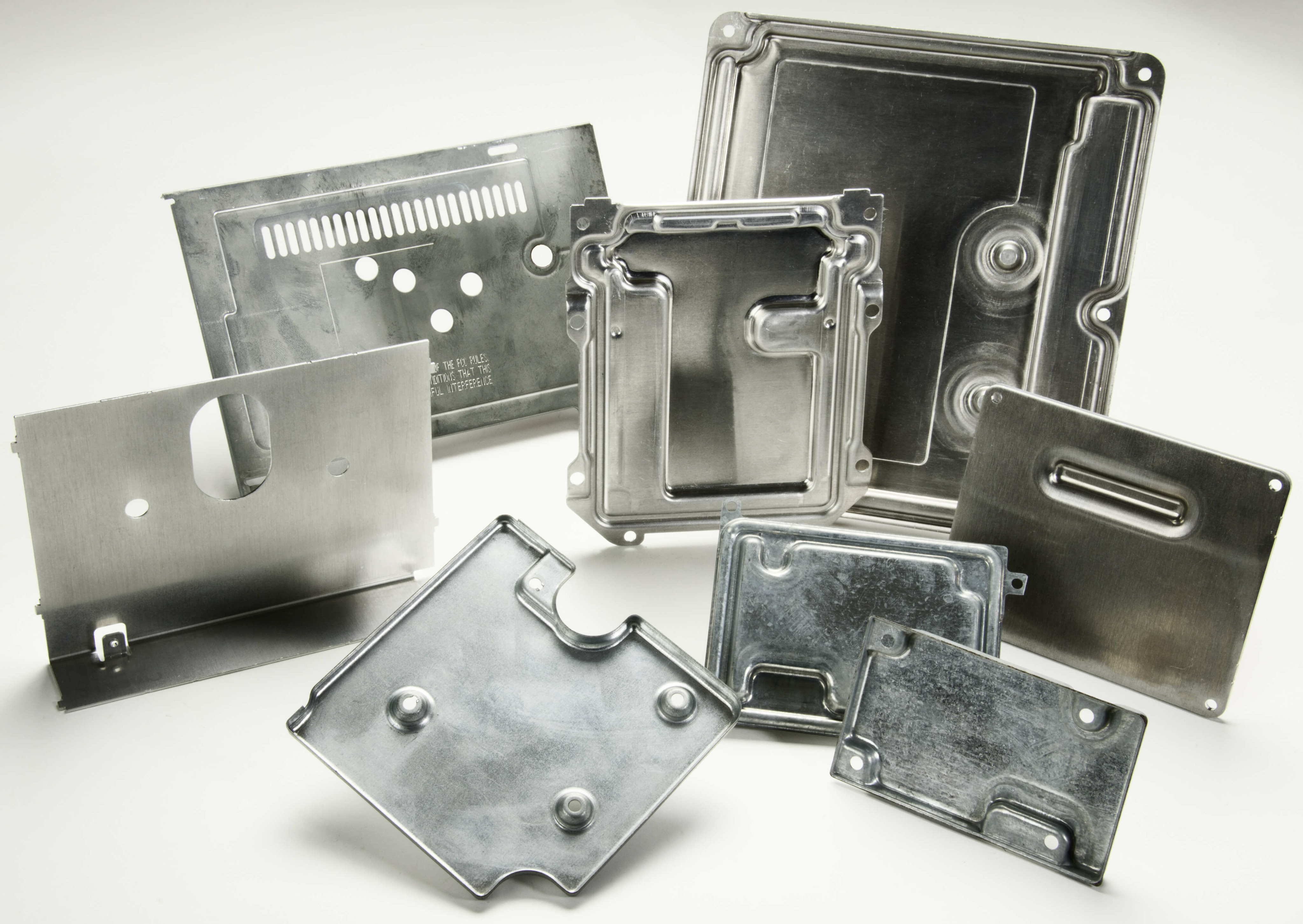
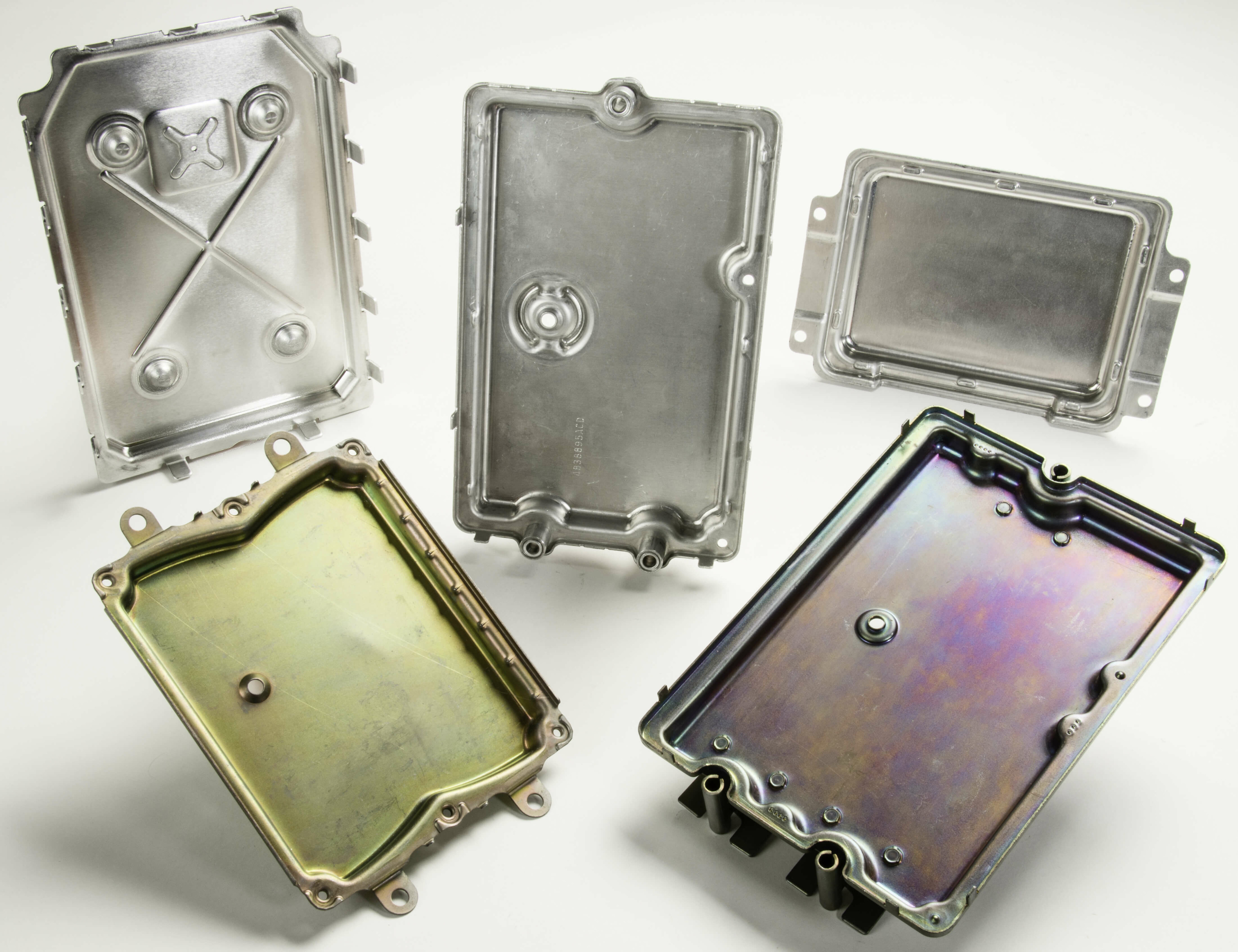
Why Stamped Aluminum ECU Housings Outperform Diecast at Volume
The shift from diecast to stamped aluminum ECU housings was not simply a cost decision. It was an engineering decision that required a supplier capable of producing a stamped aluminum enclosure that met the same sealing, flatness, structural integrity, and dimensional consistency requirements as the diecast part it replaced, at a per-unit cost that justified the tooling investment at automotive production volumes.
Stamped aluminum produces a thinner, more uniform wall section than casting, which reduces part weight and improves heat transfer through the housing wall. Diecast ECU housings require post-casting machining of the circuit board mounting surface to achieve the flatness that sensitive board mounting demands. Stamped housings, when produced with the right material handling and tooling, deliver that flatness directly out of the forming process without a secondary machining step. At production volumes of hundreds of thousands to millions of parts per year, eliminating that operation has a measurable effect on per-unit cost and program lead time.
Stamping tooling investment is also lower than diecast tooling at comparable volumes, which reduces the upfront program cost and shortens the payback period on tooling amortization. For automotive programs with long production lifecycles, that difference compounds significantly over the life of the program.
See how we built a stamped bracket assembly for an automotive electronic control module case study and cut program costs by $1,000,000.
Process Capabilities That Make Our ECU Enclosures Production Ready
Producing a stamped aluminum ECU housing or automotive control module enclosure that meets OEM and Tier 1 quality standards requires process investments that go beyond a standard stamping operation. We made those investments over many years of dedicated R&D and equipment development specifically for automotive electronic enclosure programs, and they are built into our standard production process rather than treated as special requirements.
Flatness Control for Circuit Board Mounting Surfaces
A circuit board mounting surface that is not flat creates stress on the board during assembly and introduces the risk of component damage or intermittent connections in service. Standard coil stock handling does not deliver the flatness that automotive electronics programs require before the material enters the forming process. Our raw material straighteners were custom designed specifically for this application, delivering the surface flatness that circuit board mounting demands at the incoming material stage so that flatness is maintained through forming rather than corrected after the fact.
Class A Tooling With Edge Control and Burr Elimination
Burrs at enclosure edges that contact circuit board components create a short circuit risk that is unacceptable in a sealed automotive electronic assembly. Standard tooling does not address this with the precision that automotive electronics programs require. Our Class A tooling incorporates part coining and edge control specifically designed to eliminate burrs at the geometry features most likely to contact board components. That tooling standard is not applied selectively, it is how we build tooling for every automotive electronic enclosure program we run.
Material Flow Control to Prevent Leak Paths in Sealed Units
A sealed ECU housing that develops a leak path in a corrosive environment allows moisture and contamination into the enclosure, which degrades the electronics inside and creates a field failure. Leak paths in stamped enclosures typically develop at locations where material thinning during forming reduces wall thickness below what the design assumes. We conducted extensive research and development over multiple years to understand and control material flow during the forming process at precisely the locations where thinning is most likely to occur. That process knowledge is documented and applied to every sealed enclosure program we produce.
Cleanliness Capabilities for Automotive Electronic Enclosures
Meeting the dimensional requirements of an automotive control module enclosure is necessary but not sufficient for programs that also carry cleanliness specifications. We invested in this capability specifically for automotive electronics programs, and it operates as an integrated step in our production sequence rather than as a separate secondary service.
For ISO 16232 cleanliness automotive programs, we operate custom-built in-house wash equipment capable of cleaning automotive electronic enclosures to ISO 16232:2018 standards. Washing is incorporated directly into the production sequence so that cleanliness is controlled as a manufacturing process step rather than verified as an end-of-line inspection. If your ECM housing manufacturer qualification process includes cleanliness class verification, we can provide the documentation your program requires.
Work With the ECU Housing Manufacturer That Developed the First Stamped Aluminum ECU
Your automotive control module enclosure program requires a supplier with the process knowledge, tooling capability, cleanliness infrastructure, and program management experience to meet OEM and Tier 1 standards consistently across high-volume production. Contact Perfection Spring & Stamping Corp. to discuss your ECU, ECM, or PCM enclosure requirements and find out what we can do for your program.
Need a custom solution?
If you are looking for cost reduction through design innovation, challenge us!
Frequently Asked Questions
Achievable tolerances on a stamped aluminum ECU housing depend on part geometry, material thickness, and the specific feature being controlled. Flatness on circuit board mounting surfaces, hole location for fastener patterns, and edge-to-edge dimensional control are the features that automotive electronics programs most commonly carry tight tolerances on. We review tolerance requirements during the design and quoting stage and identify any features where the specified tolerance requires specific tooling or process controls beyond our standard approach. If a tolerance is not achievable through stamping alone, we will tell you that at the design review stage rather than after first article.
From a stamping standpoint, ECU, ECM, and PCM enclosures share the same fundamental requirements: a sealed or sealable housing that protects circuit board components from contamination and mechanical damage, with a mounting surface flat enough for reliable board assembly and edges controlled to eliminate short circuit risk. The differences between them are functional and relate to what the module controls within the vehicle rather than how the enclosure is produced. An engine control unit manages engine operation, an engine control module is a broader term often used interchangeably with ECU, and a powertrain control module manages both engine and transmission functions. From a PCM enclosure stamping standpoint, the process requirements are evaluated based on the part geometry and specifications your program defines rather than the module type name.
Yes. Underhood environments expose electronic enclosures to elevated temperatures, thermal cycling, vibration, and corrosive fluids including fuel vapor, oil mist, and road spray. Material selection for underhood applications typically favors aluminum for weight and thermal conductivity, with stainless steel or electro-galvanized steel used where corrosion resistance is the primary driver. We evaluate underhood-specific requirements including temperature range, vibration exposure, and fluid resistance during the design review to make sure material selection and forming approach are aligned with what the environment demands.
Automotive ECU and control module programs typically run for years or decades, and the tooling that produces the enclosure has to maintain dimensional capability across that entire production lifecycle. We design and build tooling in-house, which means we retain direct knowledge of how every tool was built, what materials were used, and what the expected maintenance intervals are. Tooling maintenance and periodic inspection are built into our production planning rather than handled reactively when a quality issue surfaces. For programs where tooling reaches end of life during the production run, we manage the retooling process with the continuity of a supplier that built the original tool rather than handing the program to an outside shop that has to reverse-engineer what exists.
Yes. Perfection Spring & Stamping Corp. is IATF 16949:2016 certified. IATF 16949 builds on ISO 9001 and adds automotive-specific quality system requirements including advanced product quality planning, production part approval process, and measurement system analysis. For automotive OEM and Tier 1 supplier qualification processes that require IATF 16949 certification from their stamping suppliers, we can provide current certification documentation as part of the supplier qualification package.
Explore Other Industries We Serve
From automotive to construction, Medical to HVAC, and more
Perfection Spring & Stamping Corp. is a manufacturer of custom metal components, serving a wide variety of industries. Ranging from "Global Fortune 1000" companies to the individual with a patent on a single-part, we serve a diverse portfolio of customers, markets & industries around the globe.