Automotive Heat Sink Stamping & Stamped Aluminum Heat Sink Manufacturer
Perfection Spring & Stamping Corp. produces stamped aluminum heat sinks for automotive electronic modules, ADAS processors, onboard chargers, and powertrain control systems. Thermal management in automotive electronics is not a secondary concern. A control module that operates above its rated temperature range degrades in performance and service life, and the heat sink is the primary mechanism for keeping it within that range. Our automotive heat sink stamping work is built on the same aluminum forming and flatness control capabilities we developed for our ECU and control module enclosure programs, giving us a process foundation that is already calibrated to the dimensional and surface requirements that automotive electronic thermal management demands.
Our production volumes for automotive heat sink programs run from 100,000 parts to programs that exceed 3 million pieces per year. We design and build tooling in-house and produce stamped aluminum heat sinks for Tier 1 and OEM programs at Mercedes-Benz, Toyota, Honda, Subaru, General Motors, FCA, and Volkswagen, among others.
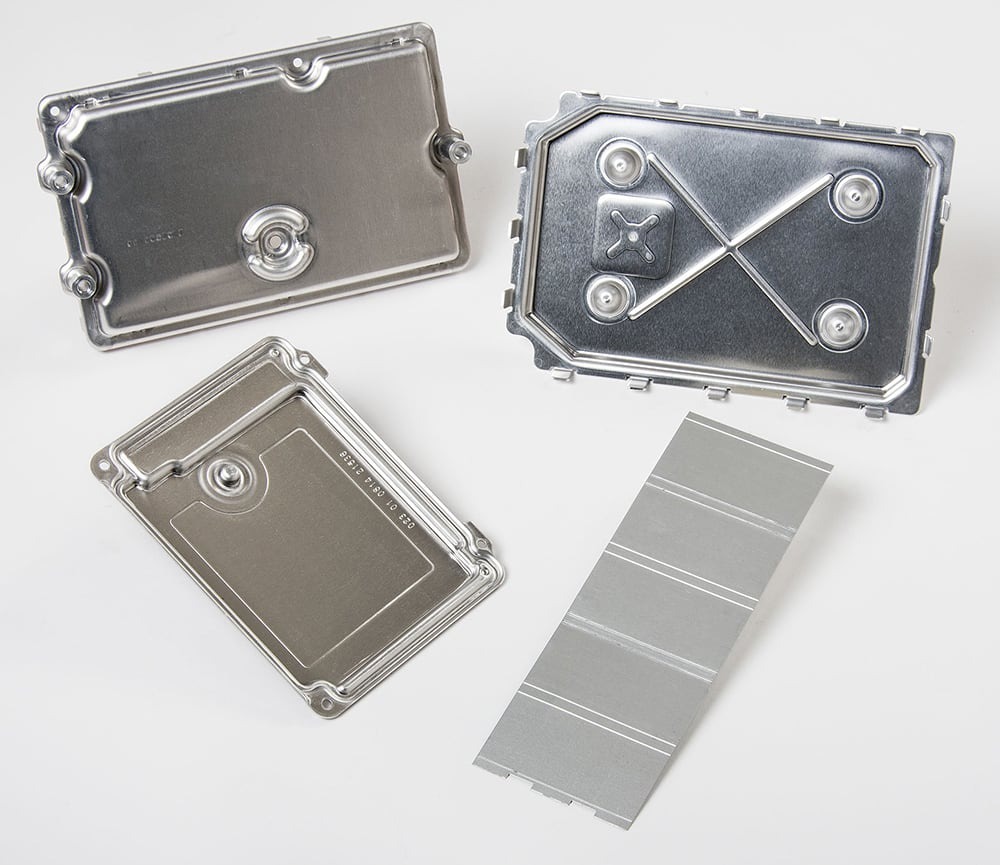

Why Stamped Aluminum Heat Sinks Work for Automotive Electronic Programs
Automotive electronic modules require heat sinks that dissipate thermal load reliably across the full range of operating temperatures and vibration conditions the vehicle generates over its service life. Stamped aluminum heat sinks meet those requirements at automotive production volumes in a way that extruded or machined heat sinks do not match on a per-unit cost basis.
Stamping produces thin, uniform fin geometries at high speed without the secondary machining operations that extrusion requires to achieve the base surface flatness and fin profile tolerances that circuit board and module mounting demands. At production volumes of hundreds of thousands to millions of parts per year, eliminating those secondary operations has a direct effect on program cost and lead time. Stamped aluminum also produces a lighter component than comparable extruded profiles at equivalent thermal performance, which matters in vehicle programs where weight reduction is an active engineering objective.
The material properties of aluminum make it the standard choice for automotive PCB heat sinks and module-level thermal management. Aluminum's thermal conductivity moves heat away from the component surface quickly, its low density keeps part weight within program targets, its formability allows fin geometries to be optimized for the airflow conditions and package constraints of the module location, and its corrosion resistance suits the underhood and cabin environments automotive modules operate in.
Stamped Aluminum Heat Sink Design and Production Capabilities
Producing a stamped aluminum heat sink that performs to an automotive program's thermal specification requires control over fin geometry, base surface flatness, material consistency, and cleanliness that standard stamping operations are not always equipped to deliver. Our process capabilities in each of these areas were developed specifically for automotive electronics programs and are applied as standard practice across all of our heat sink production work.
Fin Geometry and Surface Area Optimization
The thermal performance of a stamped fin heat sink is determined by the total surface area available for heat transfer, which is a function of fin height, fin thickness, fin spacing, and the number of fins the stamped geometry produces within the package constraints of the module location. We work with your thermal engineers during the design phase to evaluate fin geometry options against the airflow conditions, package envelope, thermal load, and fin producibility constraints of your specific program. Tooling is designed around the fin geometry your program requires rather than adapted from a standard profile, which means the heat sink your program receives is optimized for your specific thermal and packaging requirements rather than approximated from a catalog design.
Base Surface Flatness for Thermal Interface Control
The thermal resistance between a heat sink and the component it is cooling depends on how completely the two surfaces contact each other. A base surface that is not flat introduces air gaps at the thermal interface, and air is a poor thermal conductor. Those gaps increase the effective thermal resistance of the assembly and reduce how much heat the heat sink removes from the component during operation. Our raw material straighteners were custom designed to deliver the surface flatness that sensitive automotive electronic mounting demands before material enters the forming process, which means base surface flatness is controlled from the incoming material stage through to the finished part rather than corrected after forming.
Cleanliness Standards for Automotive PCB Heat Sink Programs
Automotive PCB heat sinks that are assembled inside sealed electronic modules carry the same cleanliness requirements as other components within those assemblies. Particulate contamination introduced during stamping that is not removed before assembly can migrate to connector interfaces, PCB traces, component leads, and sealed housing interiors within the module, creating contamination-related failures that are difficult to diagnose after the module is sealed. We operate custom-built in-house wash equipment capable of cleaning stamped components to ISO 16232:2018 automotive cleanliness standards, and we incorporate washing into the production sequence for heat sink programs where cleanliness documentation is required by the program specification.
Integration With Automotive Electronic Enclosure and Stamping Programs
Automotive heat sink programs rarely exist in isolation. A control module that requires a stamped aluminum heat sink typically also requires a stamped enclosure or housing, an EMI shield, and in many cases the spring finger contacts that maintain grounding continuity within the assembly. We produce all of these components, which means a program that requires multiple stamped components and springs within the same automotive electronic assembly can source them from a single supplier rather than managing separate vendor relationships for each part type.
Sourcing the heat sink and the enclosure from the same supplier has a specific engineering advantage. The interface between the heat sink and the enclosure wall or mounting surface is developed with direct knowledge of both components rather than coordinated between two suppliers after each has built their tooling independently. Interface mismatches between a heat sink and its enclosure mounting surface are a common source of thermal performance variation in production, and they are most efficiently addressed at the design stage when both components are being developed together.
Work With a Stamped Aluminum Heat Sink Manufacturer With Automotive Electronics Experience
Your automotive heat sink program requires a supplier with aluminum forming capability, surface flatness control, cleanliness infrastructure, and in-house tooling to meet OEM and Tier 1 standards consistently across high-volume production. Contact Perfection Spring & Stamping Corp. to discuss your automotive heat sink stamping requirements and find out what we can do for your program.
Need a custom solution?
If you are looking for cost reduction through design innovation, challenge us!
Frequently Asked Questions
The most useful starting point is a part drawing with dimensional tolerances, fin geometry specification, base surface flatness requirement, and annual volume estimate. If your program has a thermal performance target expressed as a thermal resistance value or a maximum component temperature at a defined power dissipation level, include that alongside the dimensional drawing so we can evaluate whether the stamped fin geometry you have specified will meet the thermal requirement or whether fin geometry adjustments should be considered during the design review. Cleanliness class requirements under ISO 16232 and any specific documentation requirements your program carries should also be included in the initial submission.
Stamped heat sinks and extruded heat sinks both move heat away from an electronic component through convection from a finned surface, but they are produced differently and perform differently across the variables that matter most in an automotive program. Extrusion produces a consistent cross-section along the length of the profile, which works well for heat sinks with uniform fin geometry and no complex features perpendicular to the extrusion direction. Stamping produces a three-dimensional formed part in a single operation, which allows for fin geometry variations, mounting features, and attachment points that cannot be produced in a single extrusion pass without secondary machining. At automotive production volumes, stamping eliminates the secondary operations that extruded heat sinks typically require and delivers a lower per-unit cost at comparable thermal performance. For programs where package constraints require complex fin geometry or integrated mounting features, stamping is often the more practical production method regardless of the volume consideration.
The fin geometries achievable through stamping depend on the material thickness, the aluminum alloy, and the tooling design. Straight fins, offset fins, pin fin configurations, and folded fin geometries are all producible through stamping within the material and tooling constraints of the specific part. Fin height, fin thickness, fin spacing, and base surface flatness are determined during the tooling design phase based on the thermal requirements and package envelope of the program. We evaluate fin geometry options with your thermal engineering team during the design review to confirm that the proposed geometry is producible within the tolerances your program requires and that it will deliver the thermal performance the module demands.
The most commonly used aluminum alloys for stamped heat sinks in automotive programs are from the 1000 and 3000 series, selected for their combination of thermal conductivity, formability, corrosion resistance, and mechanical strength. Higher purity 1000 series alloys offer the best thermal conductivity but have lower strength than 3000 series alloys, which incorporate manganese to improve mechanical properties while retaining good formability and adequate thermal conductivity for most automotive module programs. The alloy selected for a specific program depends on the thermal performance requirement, the fin geometry to be formed, the mechanical load the heat sink will carry in the assembly, and the corrosion environment the module will be exposed to over the vehicle's service life.
Yes, and that is a common program structure for automotive electronic modules where the heat sink is mounted to the enclosure wall or integrated into the base of the housing. When the heat sink and the enclosure are sourced from the same supplier, the interface geometry between the two components is developed with direct knowledge of both parts rather than coordinated between two suppliers after tooling is built. We produce stamped ECU, ECM, and PCM enclosures alongside heat sinks for automotive electronics programs, and we can quote both components together so your program has a single point of contact for the complete thermal management and enclosure assembly rather than managing that interface across two vendor relationships.
Thermal performance validation before production tooling is committed typically involves evaluating the proposed fin geometry against the program's thermal load, airflow conditions, and maximum allowable component temperature using thermal modeling tools. If the fin geometry specified on the customer drawing does not meet the thermal target under the expected operating conditions, we identify that during the design review rather than after tooling is built and first articles are tested. Where adjustments to fin height, fin spacing, or base thickness are needed to meet the thermal requirement within the package envelope, we discuss those options with your thermal engineering team before tooling is committed so the design that goes into production is one that has been validated against the performance target rather than assumed to meet it.
Explore Other Industries We Serve
From automotive to construction, Medical to HVAC, and more
Perfection Spring & Stamping Corp. is a manufacturer of custom metal components, serving a wide variety of industries. Ranging from "Global Fortune 1000" companies to the individual with a patent on a single-part, we serve a diverse portfolio of customers, markets & industries around the globe.